Why Hire a Keynote Speaker in Sydney? The Business Case for HR and Event Teams


The question is not why hire a keynote speaker for your Sydney corporate event. The question is whether the right speaker, chosen for the right goal and briefed on the right audience, delivers an outcome that justifies the investment.
After 400+ keynotes across Google, Amazon, Salesforce, NAB, elite sports teams, and some of Australia’s largest organisations, I have an honest answer to both questions. I also have a practical guide to making the case internally when your CFO or CEO asks why you are spending money on a speaker.
Here is what the evidence actually shows.
What a Keynote Speaker Actually Does for a Corporate Event
A keynote speaker does one thing a training module, an internal presentation, or a team meeting cannot do: they create a shared experience. Everyone in the room hears the same message, at the same moment, through the same voice.
That shared moment is what shifts a culture, resets a team after a difficult quarter, or signals to an organisation that its leadership is serious about change.
The specific outcomes depend entirely on the speaker, the topic, and how well the event is structured.
A generic motivational speaker leaves people feeling good for a few days. An evidence-based speaker with a documented methodology gives people tools they can apply the following Monday.
Both have a place. But they are not the same investment. If you are still weighing up the format, it is worth understanding the difference between a keynote or workshop before you commit to either.
Six Reasons Organisations Hire Keynote Speakers
Most articles on this topic list generic benefits written for event planners who are already convinced. This section frames the same reasons in the language a CFO, CEO, or board actually uses.
1. To create a cultural moment that internal communications cannot
An all-staff email or training module cannot replicate 300 people in a room hearing a credible external expert make the case for why something matters. The keynote is what gives a culture initiative its launch energy.
2. To give employees permission to talk about things that are hard to raise internally
Mental health, burnout, imposter syndrome, and performance pressure are topics most employees will not raise with a manager. When an external expert normalises the conversation on stage, it becomes safe to have it. This matters especially in high-pressure industries like financial services, legal, and technology.
3. To deliver tools that internal training rarely achieves
Most internal training delivers information. An evidence-based speaker with a documented methodology delivers tools people can apply the following Monday.
4. To signal organisational commitment to leadership and teams
Bringing in a high-quality external expert tells your people their development matters. For Sydney organisations managing change or a push toward high-performance culture, that signal carries strategic weight beyond the 60 minutes on stage.
5. To increase conference and event attendance and engagement
The speaker line-up is often the primary driver of delegate registration for professional associations and industry bodies in Sydney. A credible keynote speaker with media presence and a strong track record elevates the perceived value of the event. Directories like Professional Speakers Australia and bureaus like Saxton Speakers are useful starting points for assessing speaker credibility.
6. To accelerate change that would otherwise take months
A keynote compresses months of awareness-building into a single shared experience. It gives everyone the same language, the same framework, and the same starting point, which has real commercial value for ASX 200 organisations and high-growth Sydney companies managing rapid change.
What a Keynote Speaker Cannot Do, And Why That Matters for Your Business Case
Being honest about this will actually strengthen your internal case, not weaken it.
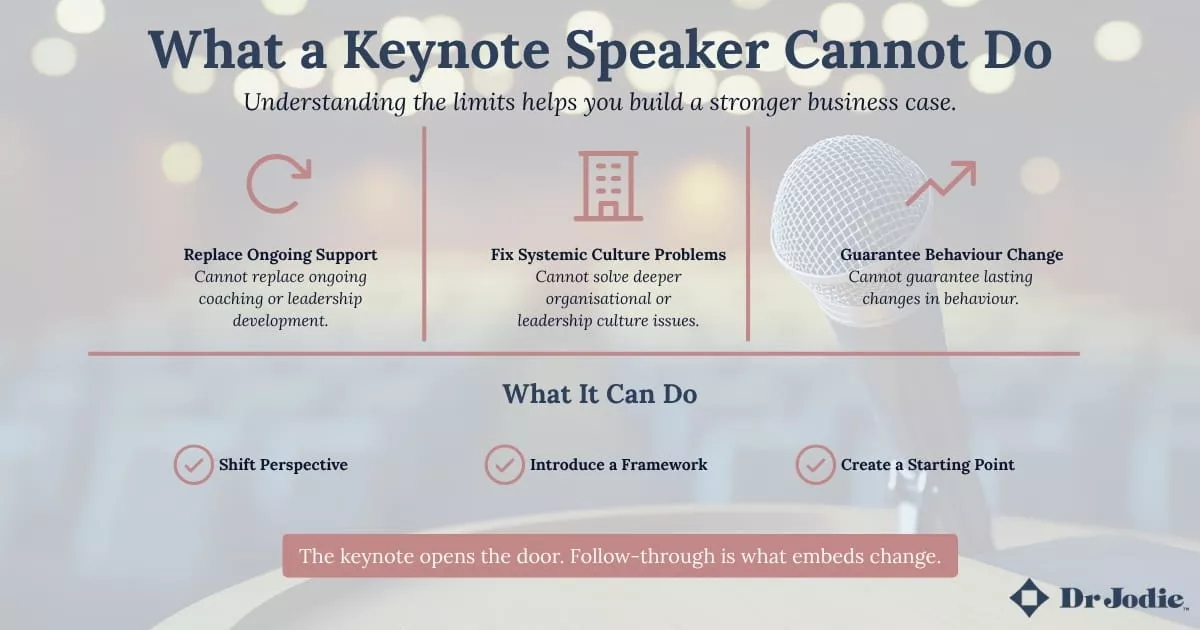
A keynote cannot replace ongoing coaching, a structured wellbeing program, or consistent leadership development. It opens the door. It does not walk through it on behalf of the organisation.
A keynote cannot fix systemic culture problems. If the leadership culture is toxic, a 60-minute session on psychological safety will not change that. The keynote has to be part of a broader strategy.
And a keynote cannot guarantee behaviour change.
What it can do is shift perspective, introduce a framework, and create the moment from which behaviour change becomes possible.
When I work with organisations that want to make keynote investment measurable, I usually recommend pairing it with executive coaching or team workshops as the follow-through. That is where the behaviour change gets embedded, and the outcomes become visible.
When to Hire a Keynote Speaker: Sydney Event Calendar Timing
Timing matters more than most event planners realise. These are the moments when a keynote investment lands hardest for organisations.
EOFY Events (May to June)
This is the most common moment organisations invest in a keynote. Teams are at peak pressure and need a reset. A keynote on high performance, resilience, or burnout placed at an EOFY leadership event or all-staff town hall lands particularly well when the audience has just lived through the period the content addresses.
Pre-Christmas Events (October to November)
The second peak period. Organisations are wrapping up the year, recognising teams, and setting the tone for January. A keynote on culture, leadership, or wellbeing closes the year on a note that carries forward.
Conference Season (March to May and August to September)
The primary booking window for professional associations, industry bodies, and large corporate conferences in Sydney. Speaker calendars for this period fill four to eight months ahead. Book early.
Post-Restructure or Change Initiative Launch
One of the highest-value moments to bring in an external speaker. The keynote provides a credible, external voice for the change narrative that leadership has been struggling to land internally.
Mental Health Month (October) and R U OK Day (September)
Specific Sydney corporate moments where a mental health or wellbeing keynote is expected. Plan three to six months ahead. Speakers are in high demand during these windows.
Understanding how much a keynote speaker costs in Australia before you approach these windows will help you build a more credible budget request internally.
How to Make the Business Case Internally: A Stakeholder Sign-Off Guide
Getting internal sign-off on a keynote speaker investment often requires a different conversation with each stakeholder. Use this guide to frame the case in the language that lands with each decision-maker.
| Stakeholder | What They Care About | Language to Use |
| CFO or Finance | Budget justification and ROI | Cost per head, connection to business KPIs like retention and engagement scores, comparison to cost of disengagement or turnover |
| CEO or MD | Strategic alignment | Connect the keynote topic to a current strategic priority: culture shift, high performance, change management, or psychological safety |
| HR or People and Culture | Employee experience and program fit | Evidence base, clinical credibility, audience sensitivity, connection to existing EAP or wellbeing strategy |
| Event Sponsor or Senior Leader | Reputation and room response | Speaker track record, client logos, bureau representation, media profile, testimonials from comparable organisations |
| Legal or Risk | Compliance and duty of care | Speaker’s AHPRA registration, evidence-based approach, no cure claims, content reviewed for compliance with Safe Messaging Guidelines |
One practical note on the CFO conversation: a $15,000 keynote for 300 people is $50 per person for an expert session with a clinically credentialed, evidence-based speaker. Framed that way, the number lands very differently than a line item on an events budget.
If you are still in the early stages of evaluating speakers, it helps to understand how to choose the right keynote speaker before you take a proposal to leadership. Having a clear selection rationale strengthens the internal case considerably.
FAQs
Why should you hire a keynote speaker for a corporate event?
You should hire a keynote speaker for a corporate event because they create a shared experience that shifts perspective, introduces a common framework, and gives an audience practical tools to apply immediately. This is something internal presentations and training modules rarely achieve at scale.
What is the difference between a keynote speaker and a motivational speaker?
The difference between a keynote speaker and a motivational speaker is the depth of what they deliver. A motivational speaker offers inspiration through personal story and energy. A keynote speaker, particularly an evidence-based one with a documented methodology, delivers a structured framework that audience members can act on after the event.
Is hiring a keynote speaker worth the investment for a corporate event?
Hiring a keynote speaker is worth the investment for a corporate event when the speaker is chosen for the right goal, briefed on your audience, and positioned correctly in the event program. A speaker with genuine depth in the topic and a track record with comparable organisations will consistently outperform a generalised inspirational story.
How do I justify the cost of a keynote speaker to my CFO or board?
You can justify the cost of a keynote speaker to your CFO or board by framing the investment in business language rather than event language. Calculate the cost per head, connect the topic to a current business priority, and reference the speaker’s track record and media profile as evidence of proven impact.
When is the best time to hire a keynote speaker for an event?
The best time to hire a keynote speaker for an event is three to six months before your preferred date, particularly for EOFY events in May to June or pre-Christmas events in October to November. You can explore keynote speakers in Sydney to get a sense of what is available before you commit to a format.
What should I include in a keynote speaker brief?
You should include in a keynote speaker brief your audience profile, event context, the outcome you are trying to achieve, any sensitivities the speaker should know about, the format and time allocation, and any follow-up activity planned after the keynote. For a full breakdown, see our guide on how to brief a keynote speaker.
Thinking About Hiring a Keynote Speaker for Your Next Event?
If you are planning a Sydney corporate event and weighing up whether a keynote is the right investment for your audience and goals, the answer usually comes down to three things: the right speaker, the right topic, and a clear outcome in mind.
Knowing why to hire a keynote speaker is only half the equation. The other half is finding someone whose credentials, methodology, and track record match what your organisation actually needs.
I work with organisations across Australia and internationally, from ASX 200 leadership teams to high-growth start-ups and government bodies.
You can explore my Sydney keynote speaking topics to see what might suit your audience, or enquire about keynote speaking directly to discuss your event, your people, and the outcomes you are trying to achieve.