How to Brief a Keynote Speaker: A Sydney Event Planner’s Complete Guide


Knowing how to brief a keynote speaker is one of the most overlooked skills in event planning. Most Sydney event planners send a one-page document with the date, venue, topic, and audience size. That is a starting point. It is not a finished brief.
After 400+ keynotes across Google, Amazon, Salesforce, NAB, and some of Australia’s largest organisations, here is what actually needs to go into a brief for a corporate event in Sydney. And what most planners leave out.
Briefing a keynote speaker well is the difference between a keynote that lands and one that misses the room. This guide covers what to include, when to send it, Sydney-specific logistics, a ready-to-use speaker briefing template, and the most common mistakes to avoid.
What Is a Keynote Speaker Brief?
A keynote speaker brief is a structured document and verbal briefing that gives a speaker the context, audience information, desired outcomes, and logistical details they need to deliver a keynote tailored to your specific event.
It is not a run sheet. A run sheet tells the speaker when to walk on stage. A brief tells them who is in the room, what the organisation is going through, and what success looks like.
The best briefs combine a written document with a briefing call. One without the other leaves gaps that show up on the day.
If you want to understand more about the role a speaker plays before you brief one, this primer on what a keynote speaker is covers the basics well.
How to Brief a Keynote Speaker: What to Include
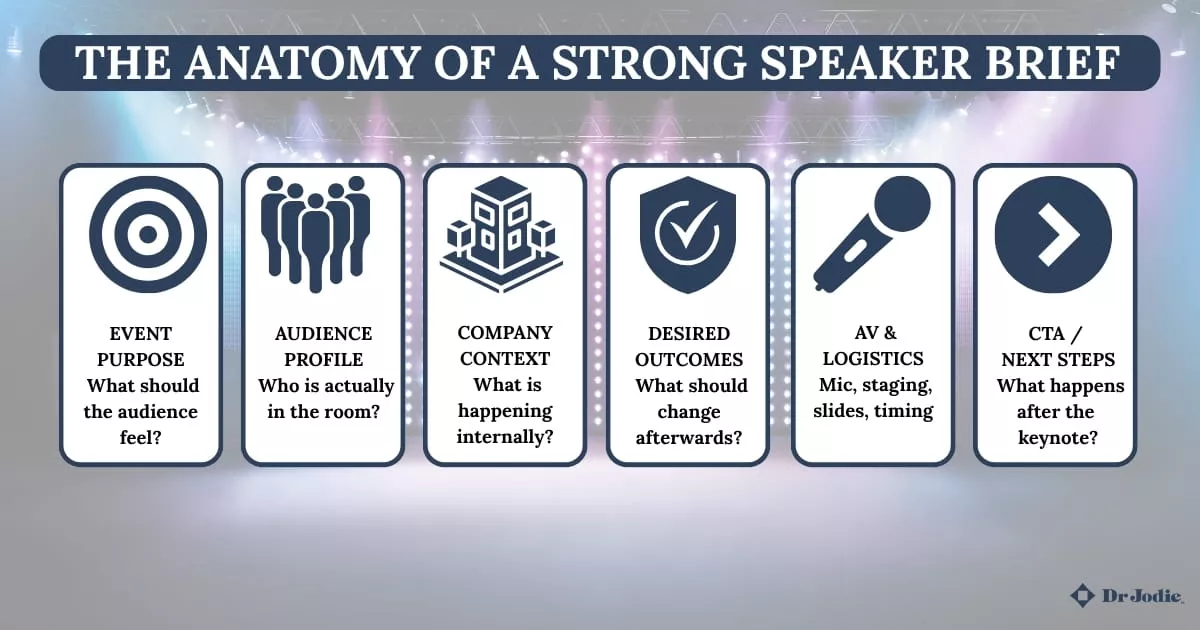
A strong speaker briefing template covers far more than logistics. The table below outlines every element a speaker needs to deliver a keynote genuinely tailored to your event, your audience, and your goals.
| Brief Element | Why It Matters | Example |
| Event purpose and feeling | Shapes tone, energy, and framing of the entire keynote | Leadership offsite to reset after a difficult quarter; the speaker must acknowledge before inspiring |
| Audience profile | Determines language, depth, humour, and examples used | C-suite executives vs. emerging leaders vs. mixed seniority all need different approaches |
| Organisational context | Prevents tone-deaf moments that undermine trust | Team through redundancies needs acknowledgement, not peak performance enthusiasm |
| Desired outcomes | Aligns the keynote to business goals | “We want people to walk away with 3 tools they can use in their next 1:1” |
| Run sheet position | Determines energy level, pacing, and audience state | Post-lunch slot needs a high-energy opener; closing keynote needs an emotional arc |
| Sensitive topics | Protects the audience and the organisation | Avoid references to internal conflicts, named individuals, or recent trauma |
| Mental health context | Critical for wellbeing-focused keynotes | Flag if the audience includes individuals who have disclosed mental health challenges. For events with a dedicated focus on wellbeing, see our mental health keynote speaker page. |
| Key takeaways | Keeps the keynote outcome-focused | “3 things we want them to remember one week later” |
| AV and logistics | Prevents technical failures | Confidence monitor position, clicker brand, slide aspect ratio, microphone type |
| Sydney venue specifics | Room shape and size affect mic choice and movement | Hotel ballroom needs a lapel mic; theatre suits a handheld; boardroom may need no mic |
| Local event trigger | Helps the speaker connect the content to the moment | EOFY event: acknowledge the intensity of the period before offering tools to reset |
| CTA and next steps | Connects the keynote to organisational action | “Close with a reference to our new leadership program launching next month” |
Timing for Sydney Events: When to Brief Your Keynote Speaker
Initial brief (as soon as the speaker is confirmed)
Send the foundational document as soon as the booking is locked in. Cover event fundamentals, audience overview, and core goals. It gets the speaker oriented early and gives them time to think before the strategic call.
Strategic briefing call (four to six weeks before the event)
Final brief (five to seven days before)
Confirm logistics, AV setup, run-of-show, and any last-minute context changes. In Sydney, this is also the moment to confirm CBD travel time and venue access details.
For pre-Christmas events (October to November), book and brief earlier than you think necessary. This is the highest-demand period for corporate keynote speakers in Sydney.
Sydney-Specific Briefing Considerations: Venue, AV, and Local Context
Venue Format Differences in Sydney
- Hotel ballroom (ICC Sydney, Hilton Sydney, Fullerton Hotel): Large room, often with round tables, requires a lapel or handheld mic; a confidence monitor is essential
- Theatre or auditorium format: Structured seating, handheld or podium mic works well, speaker movement is more constrained
- Corporate HQ boardroom or town hall: Smaller and more intimate, speaker proximity to the audience changes the energy significantly
- Hybrid event Sydney: Stage audience plus remote attendees via stream. The speaker must be briefed on camera positions and how remote Q&A will be handled
AV Checklist to Include in Your Brief
- Microphone type (lapel, handheld, or podium)
- Slide clicker (confirm brand and compatibility)
- Confidence monitor (position and distance from the stage)
- Slide aspect ratio (16:9 is standard, but always confirm)
- Stage dimensions (affect speaker movement)
- Q&A format (roving mic, fixed mic, or digital submission)
Sydney-Specific Logistics to Always Include
- CBD traffic buffer: Minimum 30 minutes before start time
- Venue access and load-in: Loading dock, security sign-in, lift access, parking
- Rehearsal window: Confirm stage walk and sound check time
- Time zone: Confirm all briefing call times in AEDT or AEST explicitly
Sydney-Specific Keynote Speaker Brief Template
| Brief Field | Sydney-Specific Detail Required |
| Venue name and format | Hotel ballroom, corporate HQ boardroom, theatre, or outdoor venue; each changes mic choice, movement, and slide visibility |
| Venue access and load-in | CBD loading dock timing, security sign-in, lift access, and parking for the speaker |
| Rehearsal window | Is a sound check and stage walk available? Allow a 30-minute CBD traffic buffer |
| AV setup | Confidence monitor position, clicker compatibility, slide aspect ratio, microphone type, stage dimensions |
| Hybrid format | Confirm camera positions, remote Q&A logistics, and whether the speaker addresses the camera or the room |
| Time zone | Confirm all times in AEDT or AEST if the speaker team or bureau is interstate or international |
| Local references to avoid | Suburb names or cultural references that may not resonate with a mixed CBD corporate audience |
| Pronunciation check | Key names, executive titles, and any Acknowledgement of Country |
| Event trigger | EOFY, pre-Christmas, or conference season; tell the speaker what pressure the audience is under |
| Traffic and arrival buffer | Confirm speaker arrival at least 60 minutes before the start. Flag major events such as Vivid or NYE |
Audience Type in Sydney: How Your Brief Should Change
| Audience Type | What the Brief Needs to Emphasise | What Success Looks Like |
| C-suite and executive leadership | Organisational context, strategic alignment, and what the speaker should and should not reference | Audience leaves with a clear framework they can apply at the leadership level |
| Mid-level managers and emerging leaders | Clear takeaways, practical tools, and explicit application to day-to-day challenges | Audience leaves with 2 to 3 tools they can use in their next team meeting |
| Association and professional conference | Industry-specific language and how this keynote fits the conference narrative arc | Keynote feels built for this specific industry and moment |
| School and education audience | Age-appropriate language and any sensitivities around mental health or family circumstances | Students and teachers leave with practical tools and feel understood |
5 Briefing Mistakes Sydney Event Planners Make (And What to Do Instead)
- Sending the brief too late. The speaker receives the document two weeks before the event, leaving no time for meaningful customisation. Send the initial brief the week the speaker is confirmed.
- Leaving the briefing to the admin team only. The senior leader must be on the briefing call, even for 20 minutes. Logistics without a strategy produces a generic keynote.
- Not telling the speaker what has happened recently. Significant organisational change, difficult news, or a high-stress period must be shared upfront.
- Skipping the AV and venue brief. Include stage dimensions, microphone type, and room layout in the written brief.
- Not defining what success looks like. Include two to three specific desired outcomes so the speaker knows exactly what the audience needs to think, feel, or do differently.
FAQs
How far in advance should I brief a keynote speaker in Sydney?
Do I need a briefing call or just a written document?
Both. A written brief covers the fundamentals. A briefing call captures nuance, context, and organisational detail that a document cannot.
What AV details should I include for a Sydney venue?
Ready to Book a Speaker Who Arrives Prepared?
Knowing how to brief a keynote speaker well is only half the equation. If you are planning a Sydney corporate event and want a speaker who arrives fully prepared, explore keynote speaking for Sydney organisations or reach out directly to discuss your event and audience.