How to Choose a Keynote Speaker for Your Sydney Corporate Event (With Evaluation Matrix)

Knowing how to choose a keynote speaker for a Sydney corporate event is one of the major decisions an event planner makes.
The right speaker sets a tone that carries through the entire day. The wrong one is expensive, visible, and very hard to explain to leadership after the fact.
After 400+ keynotes across Google, Amazon, Salesforce, NAB, elite sports teams, education, and some of Australia’s largest organisations, I have seen what separates a speaker who lands from one who does not.
This is the evaluation framework I wish every event planner had before they started shortlisting.
Start With the Goal, Not the Keynote Speaker
Most event planners start by watching showreels. That is the wrong starting point.
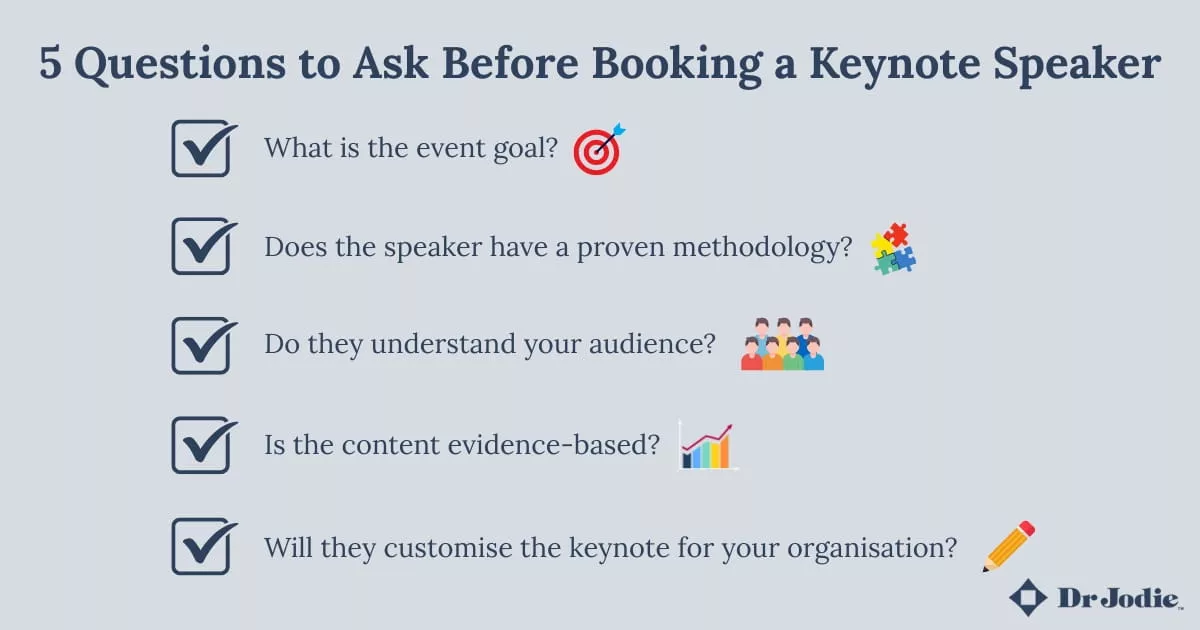
Before you choose a single speaker for your event, write down what you need your audience to think, feel, or do differently after the keynote. This one step eliminates most of the market before you have evaluated anyone.
Selecting speakers requires clarity about event objectives and success definitions. Defining event goals serves as a roadmap for every decision that follows, including which type of speaker you actually need.
Ask yourself: is the primary goal inspiration and energy, a shared framework the team can apply, normalising a sensitive topic like mental health or burnout, or signalling organisational commitment to culture change?
A speaker who is extraordinary for a sales kickoff may be completely wrong for a leadership resilience day. Clear objectives help determine the event’s purpose and guide the selection of speakers and topics accordingly.
A great keynote speaker can transform the tone of an entire event. But only if the goal drove the choice, not the name recognition.
The 9 Criteria That Actually Matter: Speaker Evaluation Matrix
Most shortlisting processes rely on name recognition, a two-minute highlight reel, and a gut feeling. Those are not reliable signals of whether a speaker will land with your specific audience on your specific day.
Use this matrix to evaluate every speaker on your shortlist. Weight the criteria against your event goal and audience type. Any red flag in the High weight category is a strong signal to keep looking.
| Evaluation Criteria | What to Look For | Red Flag | Weight |
| Relevance to your audience | Experience with your industry, seniority level, and challenges | Generic showreel, no industry specificity | High |
| Methodology depth | Proprietary framework grounded in research, not just personal story | No repeatable methodology | High |
| Evidence base | Research-backed content; can cite the science behind their tools | Neuroscience buzzwords without substance | High |
| Customisation willingness | Asks about your audience; requests a briefing call | Sends a standard rider with no questions | High |
| Track record at your scale | References from organisations similar to yours in size and industry | Only celebrity name-drops | Medium |
| Delivery style fit | Full-length recording showing 45 to 60 minutes of delivery | Only short clips available | Medium |
| Media and thought leadership | Published work and independent validation beyond their own website | No media presence or published content | Medium |
| Bureau representation | Listed with a reputable speakers bureau | No bureau representation | Low |
| Post-event follow-through | Offers resources or follow-up content after delivery | No interest in outcomes post-event | Low |
The Methodology Question: The Most Important Thing Most Planners Never Ask
Most event planners never ask this question. It is the one that separates a keynote that inspires from a keynote that actually changes behaviour.
Does this speaker have a proprietary, documented methodology grounded in research and practice, or are they telling a compelling personal story?
Both have value. But they deliver different things. A personal story inspires. A methodology changes behaviour.
If your event goal is energy and inspiration, a powerful story works. If your goal is to give your audience practical tools they can apply on Monday morning, you need a speaker with a genuine framework backed by evidence.
Here is how to evaluate this before you shortlist:
- Ask the speaker to name and describe their methodology. If they cannot do this in two sentences, they probably do not have one.
- Ask what research or clinical practice underpins their tools. A speaker with genuine methodology can answer this specifically.
- Ask what your audience will be able to do differently after the keynote. A speaker with a real framework can answer this concretely.
The Mind Strength Method is one example of what a documented, evidence-based methodology looks like in practice. Grounded in clinical psychology, neuroscience, and decades of research, it gives audiences a repeatable system, not just a memorable hour.
Reviewing a speaker’s portfolio and watching previous keynote speeches reveals whether their framework holds up across different audiences and industries.

How to Evaluate a Mental Health or Performance Keynote Speaker Specifically
Mental health and performance keynotes are now among the most requested topics at Sydney corporate events. But this category requires a different evaluation framework than that for a celebrity or storytelling speaker.
Here is what to check before you shortlist anyone in this space:
- Check their clinical or academic credentials. A speaker presenting on anxiety, burnout, or mental health should have formal training in the field, not just personal experience of it.
- Check their AHPRA registration or equivalent professional body membership if they are presenting as a clinical expert.
- Confirm they use cautious, evidence-based language with no cure claims and no guaranteed outcomes. Oversimplified mental health advice delivered to a large audience can do real harm.
- Confirm they will brief on your audience’s specific context before the event. Delivering a mental health keynote without that knowledge is a risk.
- Check their media presence and published work. A genuine expert in this space will have independent validation beyond their speaker reel.
For organisations running mental health awareness events, R U OK Day programs, burnout prevention initiatives, or leadership resilience days, this checklist is non-negotiable. The same applies to People and Culture wellbeing programs, where the audience may include people managing significant personal pressure.
If you are building a shortlist and need mental health keynote speaking in Sydney grounded in clinical expertise and evidence-based practice, the credential check is where that shortlist starts.
Sydney-Specific Considerations When Choosing a Keynote Speaker
Not all of these decisions are about the speaker themselves. Some of the most common booking mistakes in Sydney come down to logistics, timing, and local context.
Local Speaker vs Interstate or International
A Sydney-based speaker presenting at a Sydney event eliminates travel and accommodation costs. That is a meaningful saving at the professional and high-demand tiers, where keynote speaker fees can exceed $100,000, and travel expenses are often not included in the quoted fee.
A local speaker can also meet in person for a briefing call before the event. A briefing call two weeks prior ensures speaker preparedness and gives you confidence that the content will land for your specific audience.
Sydney corporate audiences span financial services, tech, healthcare, professional services, and government. Each has distinct norms. A speaker with direct local experience understands those differences without needing to be briefed on them from scratch.
Sydney Event Calendar and Timing
Event dates impact speaker availability significantly. Book during EOFY in May to June and pre-Christmas in October to November well in advance. These are the two busiest periods for Sydney corporate keynote speakers, and premium calendars lock early.
Conference season runs from March to May and from August to September. For association conferences or industry summits, the best speakers are often confirmed six to twelve months ahead.
For hybrid events with a Sydney stage audience and remote attendees, confirm the speaker’s experience with hybrid delivery. Engaging keynote presentations typically last between 30 and 60 minutes, but hybrid formats require a different technique from a standard in-person keynote.
Bureau vs Direct Booking in Sydney
Speaker bureaus like Saxton Speakers provide vetting, logistics management, and contingency planning. That is particularly valuable for high-stakes events where reliability is non-negotiable.
Professional Speakers Australia is another resource for finding and verifying professional speakers who meet recognised industry standards.
Booking direct can reduce total cost by removing bureau commission, but requires more internal coordination. For first-time bookings of a speaker you have not seen live, a bureau adds a useful layer of due diligence.
How to Justify the Investment to Leadership
Getting sign-off on a premium speaker fee is one of the most common internal challenges for event planners and HR leaders. The solution is to frame the investment in business language, not event language.
Here is how to build that case:
- Connect the keynote to a specific organisational goal. If the event is about reducing burnout, the speaker fee is part of the organisation’s wellbeing strategy, not just an event line item.
- Calculate a cost-per-head. A $15,000 keynote for 300 people is $50 per person for a high-quality expert session with practical takeaways. Frame it that way to leadership.
- Cite independent credibility signals. Bureau representation, media presence, published work, and client organisations similar to yours all demonstrate that the speaker is a proven investment.
- Confirm the customisation process. Leadership is more comfortable signing off when the content is tailored to the organisation’s specific challenges rather than delivered off the shelf.
- Share a highlight reel or testimonial from a comparable organisation. Social proof from a peer organisation is the strongest accelerator for sign-off.
Negotiating speaker contracts is also worth flagging internally. Clarity on logistics, deliverables, and cancellation terms removes ambiguity and streamlines the approval process.
FAQs
How do I choose the right keynote speaker for a corporate event?
Choose the right keynote speaker by starting with your event goal, not the speaker’s profile. Define what you need your audience to think, feel, or do differently after the keynote.
Then evaluate candidates against relevance, methodological depth, evidence base, and willingness to customise. Track record with organisations similar to yours and delivery style are strong secondary factors.
What should I look for in a keynote speaker's showreel?
Look for a full-length recording, not a highlight reel, to see how the speaker holds a room for 45 to 60 minutes. Check for energy consistency, audience engagement, how they handle transitions and Q&A, and whether the content feels tailored or generic. A highlight reel edited to two minutes tells you very little about delivery over a full session.
How far in advance should I book a keynote speaker for a Sydney event?
Book at least four to six months ahead for peak Sydney periods, EOFY in May to June and pre-Christmas in October to November. For major conferences or high-demand speakers, six to twelve months is standard.
Premium speakers in the higher fee tiers often have calendars that fill up eight to twelve months in advance during busy seasons.
What is the difference between a motivational speaker and an evidence-based keynote speaker?
The difference between a motivational speaker and an evidence-based keynote speaker is that a motivational speaker delivers inspiration through personal story. An evidence-based speaker delivers a documented methodology with practical tools your audience can apply after the event. Which you need depends entirely on your event goal.
How do I evaluate a keynote speaker on mental health or burnout?
Evaluate a keynote speaker on mental health or burnout by first checking their formal credentials and professional registration. Confirm they use cautious, evidence-based language with no cure claims, and verify they will brief on your audience’s specific context before the event. Independent media presence and published work are strong additional signals of credibility.
Find Out If Dr Jodie Is the Right Fit for Your Event
If you are building a shortlist for a Sydney corporate event and want to discuss whether I am the right fit for your audience and goals, I work with organisations across Australia and internationally across keynote speaking and team workshops.
Reach out directly to talk through your event, my topics, and my approach.